
What CIOs and CTOs Need from Technology Business Management (TBM), FinOps, and AI Cost Management
By Tiago Nascimento and Patrick Finkler
Reflections from the TBM Council Board of Directors Invitational (Phoenix, May 11–12, 2026) and IBM Think (Boston, May 4-7, 2026)
Two days at the TBM (Technology Business Management) Council’s Board of Directors Invitational, and fresh off IBM Think, we had one big takeaway: the AI conversation has flipped – from whether to invest, to whether anyone can prove it’s working.
According to Gartner’s April 2026 forecast, worldwide IT spending is expected to reach $6.31 trillion in 2026. In a separate January 2026 forecast, Gartner projected worldwide AI spending will total $2.5 trillion, with AI-optimized server spending increasing 49% and representing 17% of total AI spending.
Every CIO and CTO in the room was asking the hard question: is the spending producing real business results?
Why the C-Suite Needs AI Cost Governance
TBM Council’s Matt Guarini opened the TBMC’s Invitational with CEO stats that landed hard.
- About 75% of CEOs now call themselves the primary decision-maker for AI.
- Approximately 50% say their job is on the line in 2026 if they don’t deliver AI value, yet only 44% of projects have realized benefits, and just 4% are creating substantial value.
Guarini’s question: are CEOs in trouble, or will they come after their tech leaders first?
A Forrester insight Guarini quoted cut deeper: Stop chasing “AI for the sake of productivity and cost control,” and treat AI as a once-in-a-generation chance to redefine customer value.
 The message for CIOs and CTOs is blunt: spending is easy, activity is everywhere, value is scarce — and top leadership owns the gap.
Even Jensen Huang, CEO of NVIDIA, agrees. He discussed how AI is a once-in-a-lifetime opportunity to “elevate the capability” of organizations and people. But what about job losses? Huang says when companies lay off people, it is because leadership is out of ideas and has no reason to imagine something great.
This is precisely why CEOs need to focus on value and how TBM can help.
Measure AI Value, Not Activity
The thesis of the TBMC Board of Directors Invitational was Guarini’s framing of TBM as the “business operating system” for technology.
The case for TBM is simple. In 2025, the TBM Council found that tech spend now averages:
- 12.7% of revenue.
- 35% of tech spend sits outside the IT budget.
- 47% of IT costs are variable.
You can’t manage — or defend — IT spend without a shared language connecting cost to outcomes.
The TBM Council was founded in 2012 as a nonprofit business entity focused on improving business outcomes by giving technology, finance, and business leaders a consistent way to translate technology investments into business value through education, standards, and collaboration.
The payoff of a mature TBM framework is significant. According to TBM Council research from 2025:
- High-maturity TBM organizations deliver 3x-to-7x more impact than low-maturity peers.
- High-maturity TBM organizations report 7x greater IT operations efficiency.
- 76% say TBM helped them increase innovation funding, creating what the TBM Council describes as the “trust premium.”
That is the real payoff of mature TBM: not another dashboard, but a shared, trusted view of where technology spend goes, what value it creates, and which investments deserve the next dollar.
From AI Token Tracking to Business Outcomes
AI cost management is moving from usage accounting to business accountability. This is where FinOps and TBM are converging.
The FinOps Foundation’s 2025 Framework expanded the practice beyond public cloud via “Scopes,” pulling SaaS, data center, and AI into one umbrella. Managing AI cost is now near-universal at 98%, up from 63%.
The Linux Foundation’s June 2026 announcement of the Tokenomics Foundation underscored how quickly AI cost management is evolving. The foundation will work in close partnership with the FinOps Foundation to set standards, benchmarks, and best practices, similar to what has been established in the TBM and FinOps spaces.
In ISG’s “From Tokens to Autonomous Pricing” session, Steven Hall and Kathy Rudy moved AI cost management beyond usage tracking and toward business accountability with one of the strongest takeaways of the event: “Don’t charge back tokens. Charge back governed outcomes.”
Token tracking looks precise but rarely explains value. Many people may not even know what a token is. The real cost of AI lives in platforms, orchestration, governance, and human oversight — plus the Shadow AI hiding in expense reports. Hall and Rudy presented an Autonomy-Level Pricing model (A0 manual to A4 fully autonomous) that ties price to how work is actually done.
The board test:
The goal is not simply to count AI consumption. It is to understand which AI investments are governed, which are creating value, and which are quietly becoming the next cost surprise.
AI Maturity Is an Operating Model Problem
IBM’s Karen Butner reframed AI maturity as organizational design. The model that enterprises have been prioritizing for decades, efficiency through specialization, may now be the liability. According to the IBM’s 2026 Institute for Business Value:
- 82% of executives say functional silos are the top barrier to AI value.
- 75% expect AI to redefine their service-delivery model by the end of 2026.
Butner presented an “interconnected enterprise” that runs on agentic workflows that flow horizontally — and she pointed to TBM’s shared taxonomy as the way to map those workflows to cost and sequence investment by value.
This operating-model shift is where AI maturity becomes real. John Wilson, who was 24 months and ~100 agents into the TBM journey, summarized the practical themes of the entire event plainly:
- Start with the problem, not the technology.
- Stay anchored to the customer journey.
- Put AI in value streams, not “science projects.”
- Measure honestly — pursue value, not activity.
Together, these principles turn AI maturity from a technology rollout into a governed operating model.
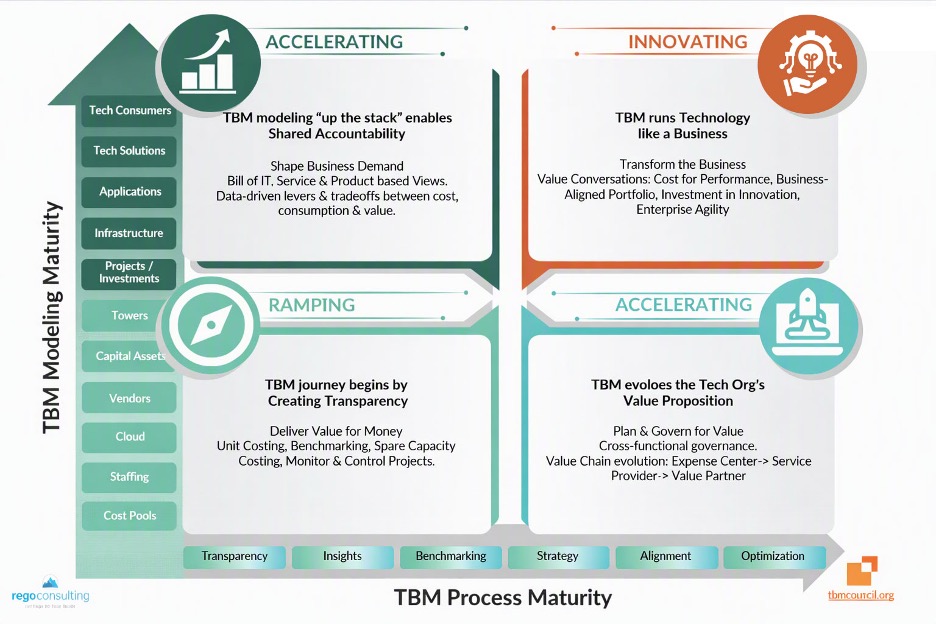
Not certain where your TBM practice stands today? Rego’s free TBM Maturity Assessment can help identify your current maturity level and highlight the highest-impact opportunities for advancement.
What Top TBM Performers Do Differently
In his “State of TBM” session, Justin Mann split organizations into Deep Divers, Treading and Swimming, and Toe Dippers. The top performers don’t do one big thing, they do five that compound:
How to Fund AI While Running the Core Business
Apptio’s Phil Alfano tackled the question that keeps finance up at night: how do you fund AI and survive the surprises?
The answer is to not “keep writing checks” or “plan for the best, pray for the rest.” Instead, fund each initiative with a distinct budget and a defined outcome.
- Alfano showed how quickly hidden value can surface: In a two-hour review of 90 days of service-desk tickets, the team surfaced $3.5 million to $4 million in potential cost avoidance. The problem was that technicians were performing hardware refreshes instead of root-cause fixes.
This is where the idea of “TBM for AI, and AI for TBM” becomes practical. The relationship works both ways: TBM brings structure and accountability to AI investments, while AI helps TBM teams find insights and value faster.
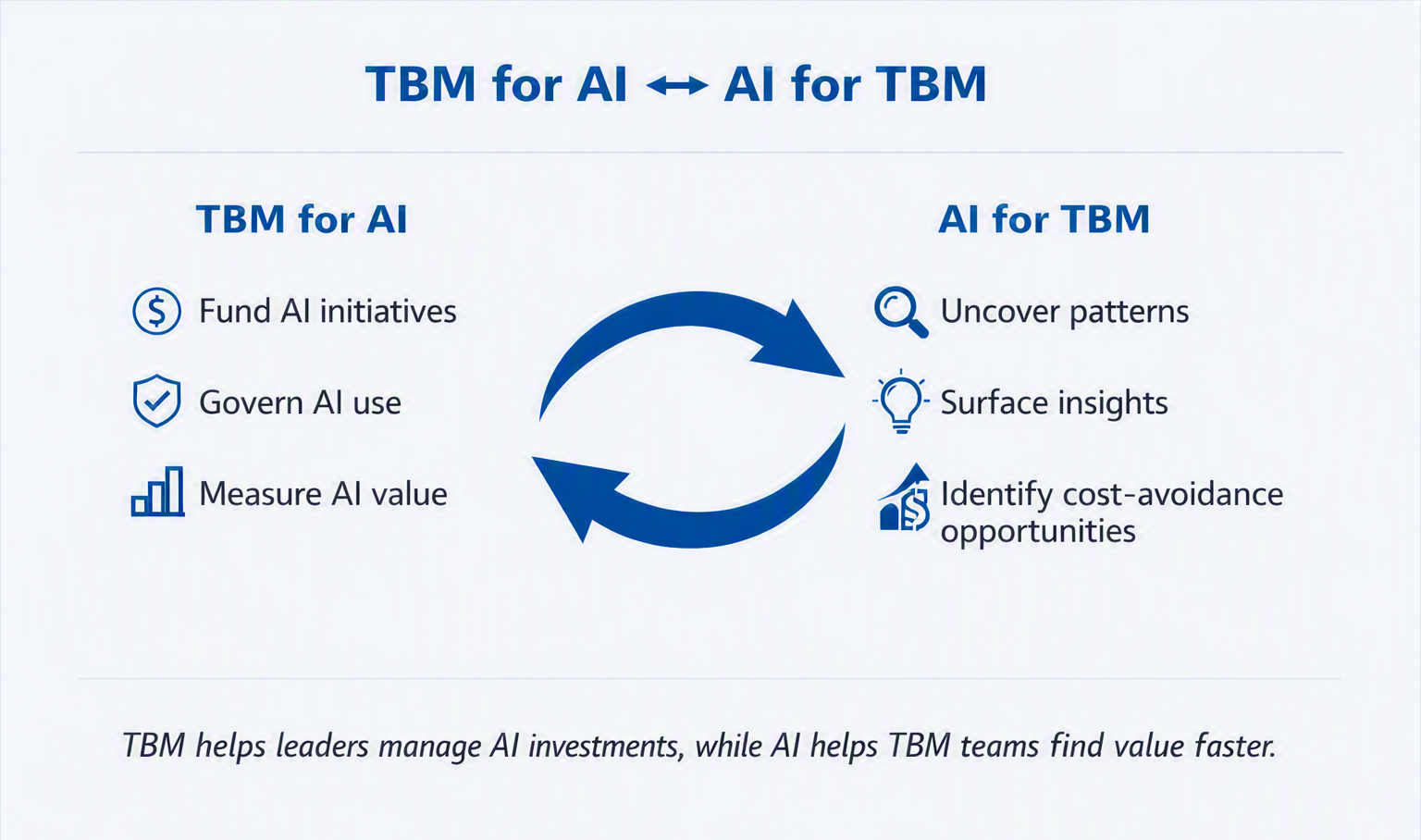
In practice, “TBM for AI” gives leaders a clear way to fund, govern, and measure AI investments. “AI for TBM” helps teams find the patterns, insights, and implement cost-avoidance before technology spend starts to build.
AI Cost Governance Priorities for CIOs and CTOs
The winners won’t be the biggest AI spenders — they’ll be the ones who connect spend to outcomes, govern it credibly, and redesign how work flows within the organization.
The path forward is short and demanding:

This is the once-in-a-generation opportunity, and a conversation worth having in your organization right now.
Need some help? Rego’s expert guides are available.
TBM Consulting for AI Governance and Cost Transparency
Rego Consulting helps organizations strengthen TBM practices, improve cost transparency, connect TBM and FinOps, and build the governance needed to manage emerging AI investments.
Whether your team is just beginning its TBM journey or ready to mature the model around AI, product TCO, service TCO, or enterprise value, Rego can help you move from visibility to action.
Ready to understand where your TBM practice stands?
Sources and Session References
Figures cited from sessions delivered at the TBM Council Board of Directors Invitational, May 2026, and from the external sources listed below.
Anthropic. “Where Things Stand with the Department of War.” March 5, 2026. https://www.anthropic.com/news/where-stand-department-war.
Apptio, an IBM Company. “Tokenmaxxing.” Conference session presented by P. Alfano at the TBM Council Board of Directors Invitational, May 2026. https://www.tbmcouncil.org/board-of-directors-invitational-2026/.
CNBC. “CNBC Exclusive: Transcript: Nvidia Founder and CEO Jensen Huang Speaks with CNBC’s Jim Cramer on Mad Money Today.” March 17, 2026. https://www.cnbc.com/amp/2026/03/17/cnbc-exclusive-transcript-nvidia-founder-ceo-jensen-huang-speaks-with-cnbcs-jim-cramer-on-mad-money-today.html.
Congressional Research Service. “Federal Government and Anthropic: Considerations for AI Innovation and Competition.” May 5, 2026. https://www.everycrsreport.com/reports/IF13217.html.
Cramer, Jude. “One Company Spent Half a Billion Dollars on Claude in a Single Month: Report Comes as AI Costs Climb.” Fast Company, May 29, 2026. https://www.fastcompany.com/91550884/claude-ai-costs-climb-company-spent-half-a-billion-dollars-in-a-single-month-report.
FinOps Foundation. “The 2025 FinOps Framework: Introducing Scopes.” 2025. https://www.finops.org/insights/2025-finops-framework/.
Gartner. “Gartner Forecasts Worldwide IT Spending to Grow 13.5% in 2026, Totaling $6.31 Trillion.” April 22, 2026. https://www.gartner.com/en/newsroom/press-releases/2026-04-22-gartner-forecasts-worldwide-it-spending-to-grow-13-point-5-percent-in-2026-totaling-6-point-31-trillion-dollars.
Gartner. “Gartner Says Worldwide AI Spending Will Total $2.5 Trillion in 2026.” January 15, 2026. https://www.gartner.com/en/newsroom/press-releases/2026-1-15-gartner-says-worldwide-ai-spending-will-total-2-point-5-trillion-dollars-in-2026.
IBM Institute for Business Value. “The Interconnected Enterprise.” Conference session presented by K. Butner at the TBM Council Board of Directors Invitational, May 2026. https://www.tbmcouncil.org/board-of-directors-invitational-2026/.
Information Services Group. “From Tokens to Autonomous Pricing.” Conference session presented by S. Hall and K. Rudy at the TBM Council Board of Directors Invitational, May 2026. https://www.tbmcouncil.org/board-of-directors-invitational-2026/.
Rego Consulting. “Assess and Improve Your TBM Maturity Level.” Accessed May 18, 2026. https://regoconsulting.com/maturity-assessment/.
Rego Consulting. “Technology Business Management (TBM) Consulting.” Accessed May 18, 2026. https://regoconsulting.com/tbm/.
TBM Council. “Founder and Advisor.” Accessed August 5, 2026. https://www.tbmcouncil.org/about/founder-and-advisor/.
TBM Council. “Opening Remarks.” Conference session presented by Matt Guarini at the TBM Council Board of Directors Invitational, May 2026. https://www.tbmcouncil.org/board-of-directors-invitational-2026/.
TBM Council. “State of TBM 2025.” Conference session presented by J. Mann at the TBM Council Board of Directors Invitational, May 2026. https://www.tbmcouncil.org/board-of-directors-invitational-2026/.
Tokenomics Foundation. “Announcing the Tokenomics Foundation.” June 3, 2026. https://www.tokeneconomics.com/about/.

About the Author: Tiago Nascimento