
Modern IT leaders are being asked to do two things at once:
- Mange total cost of ownership (TCO)
- Accelerate delivery
That sounds simple. But every technology decision rests on systems, teams, processes, applications, infrastructure, vendors, projects, and manual work. A software license may be easy to see. However, the real cost of keeping that application running, connected, governed, supported, and useful over time is harder to measure.
Traditional total cost of ownership conversations often fall short, reducing TCO to an application costing exercise. That is understandable – applications have owners, contracts, licenses, support teams, and renewal cycles. Leaders ask, “How much does this application cost?” That is an important question, but it is not the only question.
A strategic TCO practice asks:
This article looks below the surface of traditional TCO to uncover hidden cost drivers. It shows how deeper insight can improve strategy, governance, and business outcomes.
Total Cost of Ownership Is More Than Application Costs
Modern IT costs go far beyond applications.
A tool may look inexpensive on paper while still creating downstream work for IT, finance, architecture, operations, or business teams. Cost can accumulate through integrations, infrastructure, service models, labor, support processes, data movement, and manual work. Governance and decision-making can create additional expenses.
These unseen costs add up. That is why leaders need a deeper view.
Rego Consulting has seen this challenge firsthand. In one client environment, a cost center owner was preparing to migrate from an on-premises tool to a SaaS platform. The team expected the SaaS option to cost less over time. However, it lacked the TCO data needed to show current-state costs, future-state costs, and expected savings.
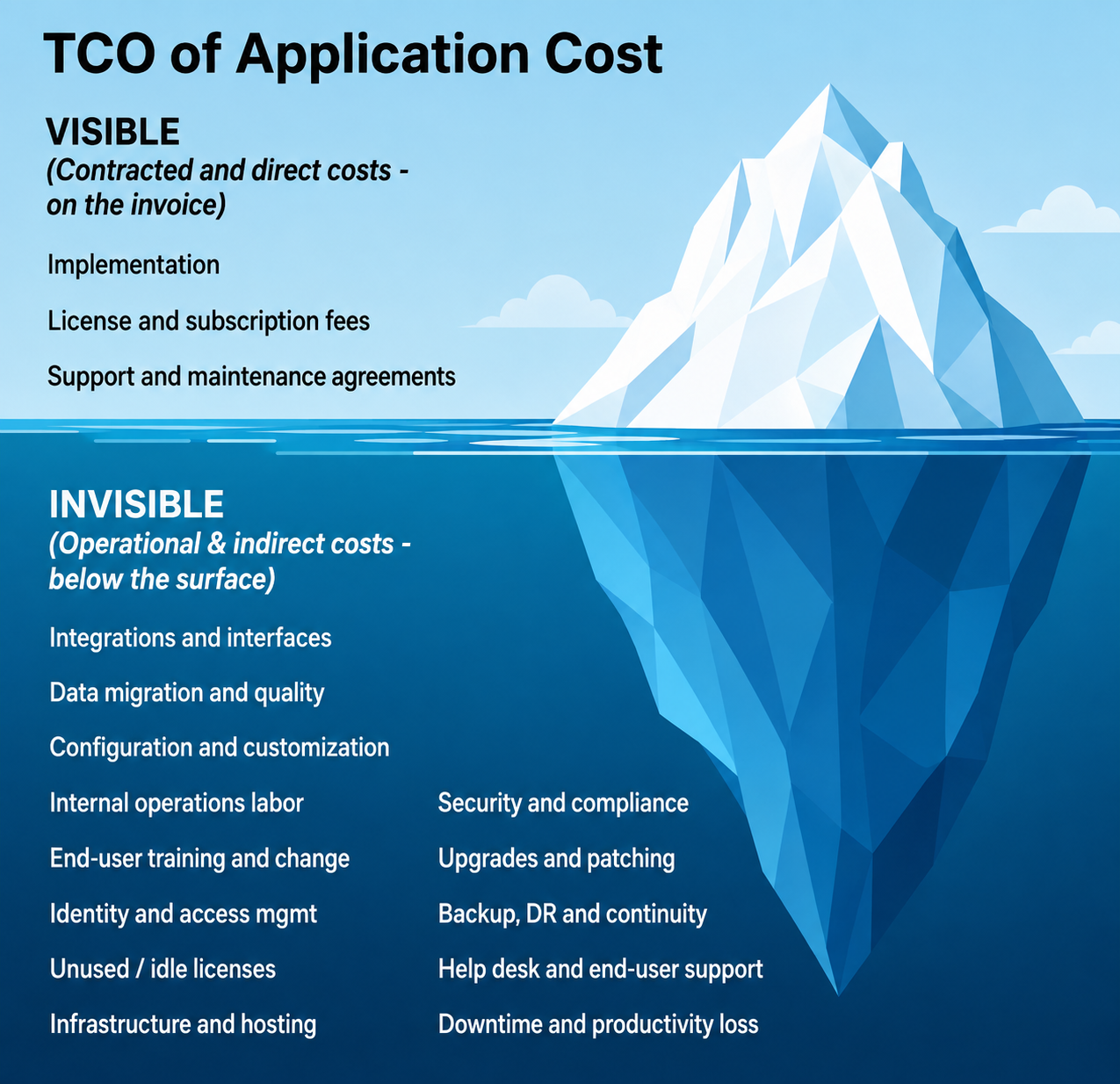
TCO of Application Cost Iceberg. Concept and design by Rego Consulting.
Deeper TCO visibility moves cost conversations from instinct to evidence. A modern TCO framework shows what a technology investment costs and why. It also reveals the underlying cost drivers, users, and business value the investment supports. This gives leaders the context to make clear and confident decisions.
The Leadership Shift: From Cost Control to Value Management
When TCO is treated only as a financial metric, cost management often becomes reactive.
- Teams look backward, explain spend, and search for cuts.
When TCO is treated as a unified leadership lens, it becomes strategically proactive, and empowers better decisions.
- Leaders can understand the cost of current-state systems, evaluate alternatives, identify underused tools, prioritize investments, and govern technology with more confidence.
- They can also align IT, finance, architecture, and business teams around the organization with a shared view of cost and value.
A deeper understanding of TCO is especially important in complex enterprise environments, where no single team sees the whole picture.
A strong TCO practice brings each group’s part of the story together. Leadership brings strategy. Finance brings spend. IT brings technical context. Architecture brings dependencies. Application owners bring usage and ownership.
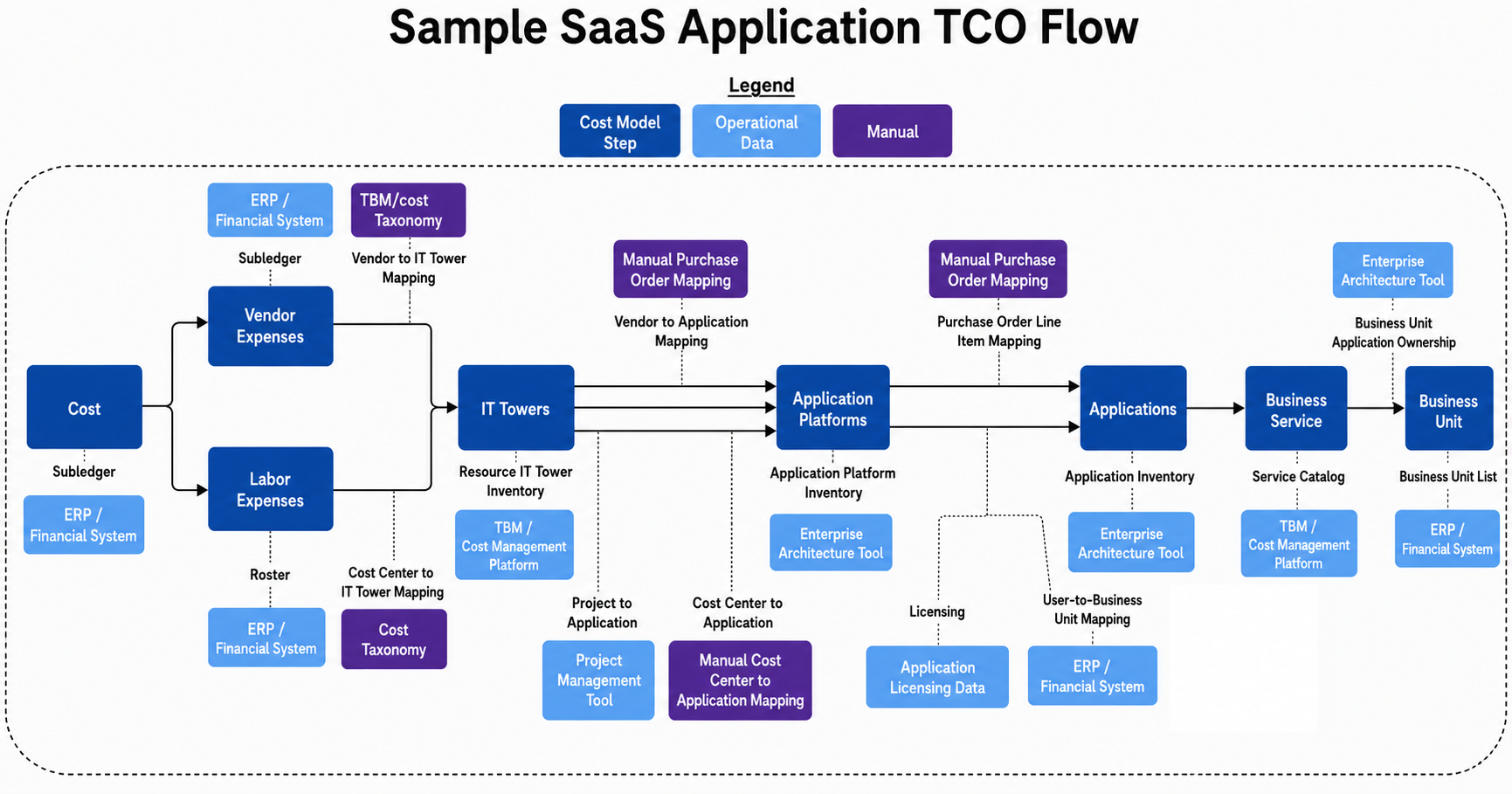
The Modern IT Framework: What Leaders Need to See
A modern IT framework should help leaders connect the dots between cost, scale, and sustainability. That means understanding the layers that shape total cost over time.
At a practical level, this includes:
Total cost of ownership becomes more strategic when leaders understand not only what they are spending, but how well that spend supports the business.
Remember, you don’t need to create a perfect model on day one. As you build a model that helps your leaders make better IT decisions, help is available.
Optimize TCO with Apptio
Many organizations are already building pieces of a TCO model, even if the work is happening manually. Teams may be collecting costs, mapping vendors, reconciling application ownership, or building business cases through spreadsheets and side processes. Those manual efforts can be useful, but they are hard to scale and difficult to govern over time.
A tool-supported approach helps save time and money by making the process more standardized, visible, actionable, automated, and scalable.
How Apptio Makes TCO More Actionable and Automated
Apptio supports Technology Business Management (TBM), IT cost transparency, cloud cost management, planning, forecasting, and value optimization. Together, these capabilities make TCO more actionable by connecting technology spend with business context. Leaders can visualize and understand costs across applications, services, platforms, and infrastructure.
Apptio can make TCO practices more repeatable by automating cost-data consolidation and connecting financial and operational data. It can also support structured TCO views across cloud, hybrid IT, mainframe, products, and applications. Instead of rebuilding the story each time a cost question comes up, leaders can work from a more connected view of spend, usage, ownership, and value.
Apptio Mainframe TCO: Cost and Usage Insights
IBM Apptio Mainframe Total Cost of Ownership (TCO) is one example of how organizations can take a deeper look at technology cost. According to Apptio, the solution provides a unified, data-driven view of mainframe TCO, usage, and consumption. This supports more accurate cost allocation, utilization tracking, and data-driven decisions.
One of the most valuable aspects of these reports is that they enable users to see data from different angles:
- Application
- Service
- Platform
- Business unit
- Infrastructure
- Operational cost drivers
Here are two examples.
1. Apptio Mainframe Cost Transparency and Allocation:
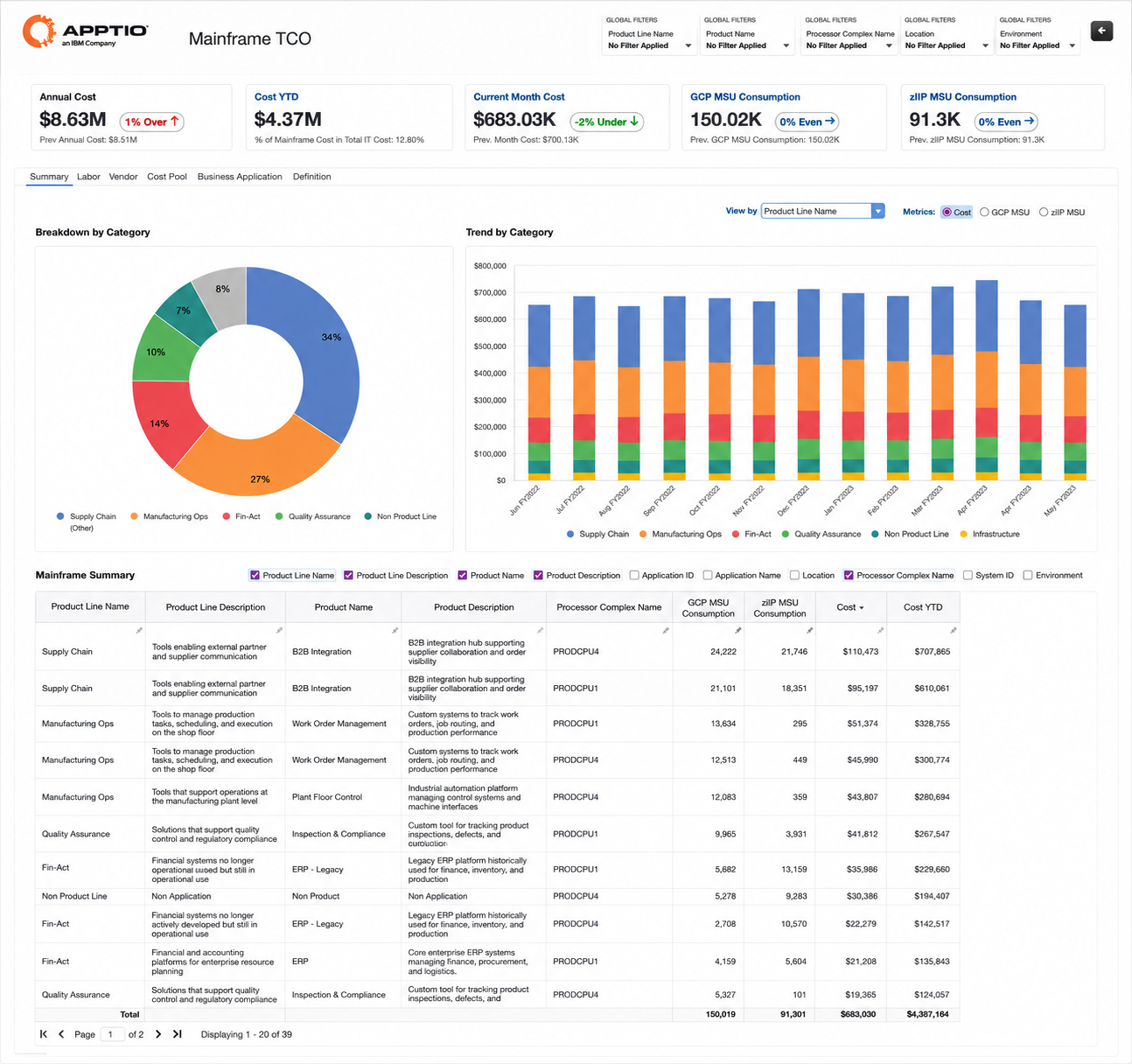
2. Apptio Mainframe Unit Rates and Consumption Insights:
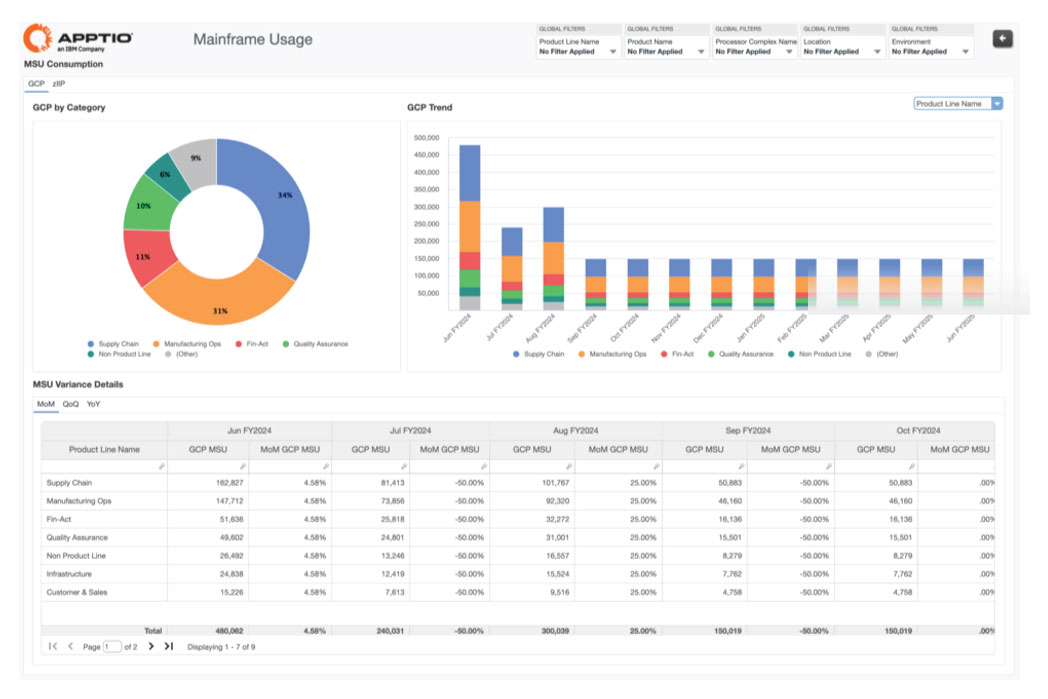
TCO can be more than reporting – it can become a practical input for strategy, prioritization, modernization, and governance. With deeper cost transparency, leaders can move the conversation from “What did we spend?” to “What are we funding, what business value does it create, and what decisions should we make next?”
Real-World Example: From Manual Reporting to Decision-Ready TCO
During a Rego-supported Apptio engagement, a global automotive manufacturer cut monthly actuals reporting from one month to two days and gained a centralized, automated view of IT costs.
Results included:
- 93% increase in report productivity → reduced cycle from one month two days
- Expanded Apptio adoption to 200+ users, achieving a 95%+ adoption rate
- Began using Apptio to manage nearly 400 cost centers and hundreds of millions of dollars in IT spend.
Utilizing strategic TCO, the organization also began tracking application cost of ownership across resource, infrastructure, overhead, and license costs. This gave leaders a stronger TCO foundation for IT investment decisions.
- See the full case study here: Rego experts help improve reporting, adoption, and cost monitoring
- Explore additional case studies in the Recommended Resources section below.
How Rego Can Help
Rego Consulting helps organizations like yours connect strategy, systems, and cost reality.
With decades of experience across complex enterprise environments, Rego’s expert guides help organizations improve cost transparency, strengthen TCO and TBM practices, optimize Apptio reporting, support governance and operating model design, and move faster from concept to value.
Rego’s expertise extends beyond technical configuration into strategic solutions. Our team helps organizations turn cost data into decision-ready insight, so your leaders can better understand what they are funding, where costs are changing, and how technology investments support business value.
Rego can make your TCO more visible, more usable, and more connected to real business decisions.
Recommended Resources

About the Author: Trae Baker