
The knowledge stays. The context compounds. That’s the difference between a tool and infrastructure.

Every organization I talk to already has ChatGPT. Most have Copilot. Some have three things running at once. They’re getting value from all of them.
None of it belongs to the organization. None of it compounds. And none of it knows what’s on Grants.gov this morning.
That’s the gap. Here’s what actually closes it.
Jennifer Walsh has been the Development Director at a Chicago food bank for six years. She knows every major funder, every reporting deadline, every quirk in every grant agreement. She has a system — partly in the CRM, partly in her head, partly in a folder on her desktop that she’s been building since 2019.
In March, she gave notice.
Her replacement starts in June. She will be smart, capable, and motivated. She will also spend the first six months rebuilding context that Jennifer spent six years accumulating. The grants won’t wait.
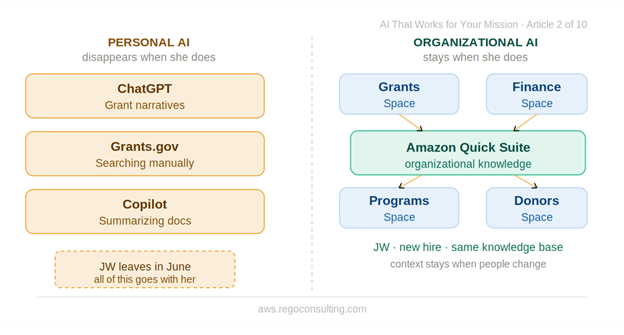
This is the problem that ChatGPT, Copilot, and every other AI tool currently in use doesn’t solve — and can’t. Not because they’re bad tools. Because they’re personal tools. They amplify the individual using them. They do nothing for the organization when that individual is gone. Every staff member builds their own private workaround: their own prompts, their own shortcuts, their own folder nobody else can find. None of it is visible across the team. None of it is searchable. All of it evaporates when someone leaves.
Jennifer is a composite — but I’ve had this conversation more times than I can count.
Amazon Quick Suite is a different category of thing entirely. It’s built for the organization — not the person sitting at the desk today. The knowledge stays. The context compounds. And when someone new sits down in June, she doesn’t start from scratch.
— Personal AI disappears when the person does. Organizational AI stays. —
I’ve run PMOs at HSBC and Nokia and led lines of business at startups. The tension between governed process and personal flexibility is the thing that breaks most technology deployments — in both directions. Lock it down too tight and nobody uses it. Leave it entirely personal and nothing compounds. Amazon Quick Suite is the first platform I’ve seen that actually holds both sides of that equation at once.
Spaces: where the knowledge lives
Most organizations already have the tools — CRM, grants platform, accounting system, Google Workspace — and have inadvertently built exactly the fragmentation problem those tools were supposed to solve. Each one works. None of them talk to each other. The Executive Director is the only integration point, connecting them in her head, on nights and weekends, before board meetings and funder calls.
Spaces solve that problem. A Space is a governed collection of content — documents, data sources, connected systems — that the AI can read, search, and reason across. Not a single database someone has to maintain. A connected environment that brings the right sources together in one place.
Some of what lives in a Space is static — historical grant applications, board policies, program documentation, past compliance reports. Some of it is dynamic: Grants.gov updated every morning without anyone touching it, Candid funder profiles refreshed automatically, OMB guidance monitored for changes. The grants manager doesn’t pull the weekly funding landscape summary. It’s already there when she opens her laptop.
A typical organization gets Spaces organized around how the work is actually done. A grants Space holds everything related to funding. A donor relations Space holds CRM history, cultivation notes, stewardship records. A finance Space connects to budget and accounting data. Some knowledge belongs to the whole organization — sector news, regulatory frameworks, public funder databases — and lives in a shared organizational Space every team can draw from. Some knowledge belongs to a specific team and stays there.
That last point matters more than it might seem. The grants manager doesn’t accidentally see donor conversations. The finance team doesn’t have access to program case files. The Executive Director can see across all of it. Access is set by the organization, for the organization — and it stays that way.
— The knowledge doesn’t belong to the person who accumulated it. It belongs to the organization. That’s a different proposition entirely. —
Chat Agents: the right answer, not just an answer
It’s a Tuesday morning and Jennifer needs to know whether the Annie E. Casey Foundation is still prioritizing workforce development programs in the Midwest — and what their current language says about match requirements. She could spend an hour searching. She could ask ChatGPT and get something plausible that may or may not reflect what Casey actually published last month.
Or she could ask her Chat Agent.
A Chat Agent is a purpose-built AI assistant configured for the organization’s specific context. Jennifer’s draws from three layers simultaneously: everything the organization knows internally — application history, funder relationships, past award terms — curated public sources the organization has chosen to monitor, and the live web when the question requires it. It doesn’t guess. It returns an answer grounded in what Casey actually said, cross-referenced against what Jennifer’s organization has actually done with them.
That’s not a general AI assistant. It’s a specialist that knows this organization’s context — because it’s built on this organization’s knowledge.
There’s something else worth naming. The conversation Jennifer had in October about Annie E. Casey — the reasoning she worked through, the questions she asked, the answer she got back — is still there. The organization accumulates decision-making history, not just documents. When Jennifer’s replacement sits down in June, she doesn’t start from a blank page. She starts from six years of institutional reasoning that Jennifer left behind without knowing she was doing it.
The new grants manager asks the same questions Jennifer did. She gets the same quality of answer. Not because she has Jennifer’s experience — because she has Jennifer’s knowledge base.
Quick Research: evidence, not guesswork
Most of the research that happens in a nonprofit development office is invisible work. Reading through federal agency priorities. Cross-referencing funder databases. Tracking what’s changed in compliance guidance since the last application cycle. It happens in browser tabs, late on Tuesdays, by people who are already running at capacity.
Quick Research automates that process. Give it a question — which foundations are currently prioritizing food security programs in the Midwest, what has OMB updated in the last revision to federal cost principles, what are the top three workforce development funders in Illinois right now — and it runs a multi-step research process against authoritative sources: Grants.gov, Candid, OMB, sector databases, the organization’s own application history.
It doesn’t return a guess. It returns an answer with citations the team can verify.
The shift isn’t just speed. It’s what the development director does with the two hours she gets back. Research that used to be invisible work becomes a decision brief on her desk before the board meeting.
When a team member pastes grant financials, client records, or program data into a public AI tool to get work done faster — and they will, because it works — that’s not just an efficiency decision. That’s a data handling decision with compliance implications that most organizations haven’t addressed.
Quick Flows: the work that should run itself
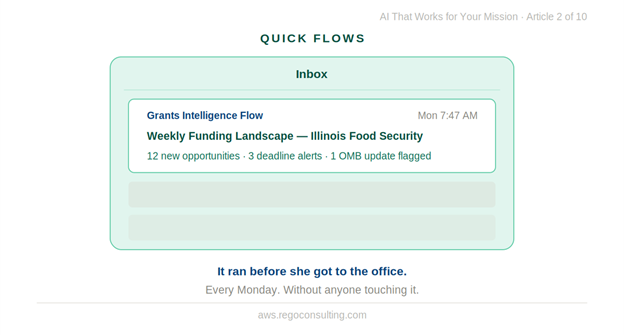
Every Monday morning, Jennifer spent forty-five minutes pulling the same funding landscape summary. New opportunities on Grants.gov filtered for food security programs in Illinois. Status updates on active applications. Deadline alerts for the week ahead. The work wasn’t hard. It was just hers, every week, without exception.
One afternoon she described what she wanted in plain English — what sources to check, how to filter the results, where to send it, what time Monday morning it should arrive. Quick Flows built it. She tested it. It ran the following Monday before she got to the office.
She never did it manually again.
Quick Flows are automated workflows any staff member can build without coding, without IT involvement, and without waiting on anyone else. The no-code design is not a feature — it’s the point. The person who feels the pain builds the solution. The grants manager who spends every Tuesday morning compiling a compliance status report doesn’t file a ticket. She describes what she needs and the Flow builds itself.
Jennifer shared her funding landscape Flow with the development team before she gave notice. It’s still running. Her replacement has never pulled that summary manually. She doesn’t know she’s benefiting from something Jennifer built — which is exactly how organizational infrastructure should work.
The outputs go where the work already happens. A Flow that generates a donor acknowledgment letter delivers it directly into Outlook, ready to send. The team doesn’t learn a new tool. The work finds them.
— It ran before she got to the office. Every Monday. Without anyone touching it. —
Quick Sight: seeing the whole picture
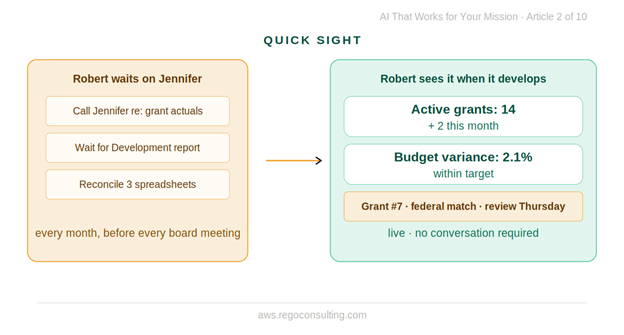
Robert Chen has been the Finance Director at the same food bank for four years. Every month, producing the board report requires two conversations with Jennifer — one to understand which grants are in which phase, one to reconcile the actuals she tracks against the budget he tracks. Neither conversation is long. Both are non-negotiable.
In March, Jennifer gave notice. Robert’s first call after the all-staff meeting wasn’t to HR. It was to figure out how he was going to close April’s books without her.
Robert is also a composite. But the Finance Director who depends on the Development Director to explain the numbers is in nearly every small nonprofit and small business I’ve worked with.
Quick Sight is the layer that breaks that dependency. Not by replacing Jennifer — but by connecting Robert’s view of the financials directly to the same data the grants team works from, updated in real time, without a conversation required.
Dashboards that pull from the organization’s Spaces: grant pipeline against budget, program outcomes against funder commitments, compliance status across active awards, donor performance against campaign goals. Not a report someone runs at month-end. A live view that updates as the underlying data changes.
For nonprofits and small businesses alike, the function is the same — turn the activity across connected data into a picture the leadership team can act on before the deadline, not after. Robert doesn’t find out about a budget variance when the federal report is due. He sees it when it develops.
And because Quick Sight is part of the same platform as everything else — the same Spaces the grants team uses, the same Flows that run Monday morning — what Robert sees in his dashboard is connected to the work that’s actually happening. Not a snapshot exported from three systems last Tuesday. A live view.
— Robert doesn’t find out about a budget variance when the federal report is due. He sees it when it develops. —
Why this matters right now
Maria Chen has been the Executive Director of a Chicago food bank for eleven years. She’s navigated recessions, a pandemic, and three changes in federal administration. She knows how to read a funding environment.
On a Tuesday morning in February, she read the notice.
Federal grant freeze. Immediate review of all discretionary spending. No timeline for resolution.
She didn’t panic. She’d seen versions of this before. What she felt was something more specific — the particular weight of knowing exactly what she needed to do and not being certain the organization could move fast enough to do it. Which funders to call first. Which programs were most exposed. Whether the compliance documentation on the three active federal awards was audit-ready right now, today, if someone asked.
She knew some of those answers. She didn’t know all of them. And the ones she didn’t know were going to take days to find out.
Maria is a composite. But I have had this conversation with Executive Directors across the country in the last sixty days. The details change. The weight doesn’t.
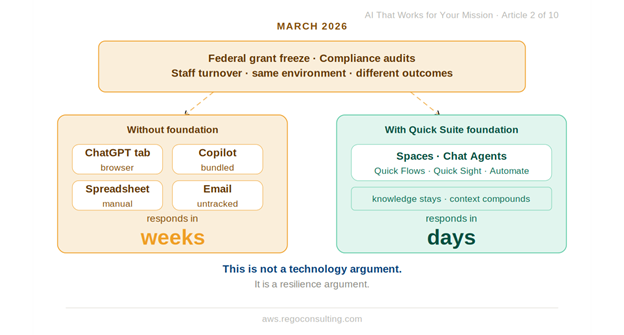
This is not a moment for a general AI tool. ChatGPT doesn’t know which of Maria’s active grants carry the highest federal exposure. Copilot doesn’t know whether her subrecipient documentation is current. A browser tab doesn’t know what changed in OMB guidance last month.
This is what Quick Suite does.
The funding landscape is in the system — Grants.gov, Candid, federal agency priorities, funder histories — updated automatically, searchable in seconds. When the freeze notice lands, the Development Director isn’t spending Tuesday reconstructing information that should already exist. She’s already looking at it.
This is what Quick Suite does when the environment gets harder.
The compliance documentation is connected — active awards, OMB requirements, audit trails, subrecipient records — in one governed environment where the Finance Director and the ED can both see the same picture at the same time. When a federal auditor calls, the answer isn’t “let us pull that together.” The answer is already there.
This is what it means to run on infrastructure instead of individual knowledge.
The institutional knowledge stays. Jennifer’s replacement is running grant coordination. Robert isn’t waiting on anyone to explain the numbers. The processes that used to live in individual people’s heads are running on infrastructure that doesn’t give notice.
When the environment gets harder, organizations with this foundation respond in days. Organizations without it respond in weeks — if they respond at all.
— Same pressure. Same environment. Organizations with a foundation respond in days. Organizations without respond in weeks. —
Quick Automate: when the work has to think
Jennifer coordinated grants the way most people in her role do — through memory, relationships, and calendar management nobody ever wrote down. When a new RFP came in, she knew which program director to call, which compliance requirements to check, and whether the budget could absorb the match. She didn’t follow a process. She was the process.
Her replacement started in June with none of that context. Before Jennifer’s last day, the organization mapped how grants coordination actually worked — the steps, the decision points, who needed to see what. Quick Automate turned that description into a process that runs without anyone holding it together.
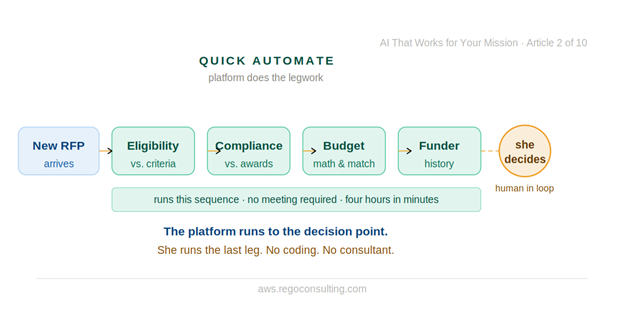
When a new RFP lands now, the sequence runs on its own. Eligibility checked against program criteria. Compliance requirements flagged against current awards. Funder history pulled from the Development Space. Budget math surfaced from Finance. Program director notified with a summary of what was found. The whole sequence stops and puts a brief in front of the grants manager before anyone schedules a meeting.
She reviews it. She decides whether to apply. She makes the call.
Quick Automate didn’t replace her judgment — it did four hours of coordination in the time it took her to get coffee, so judgment is the only thing left on her plate.
This is the distinction from Quick Flows. Flows is what a staff member builds herself on a Tuesday afternoon — recurring, structured, personal productivity. Quick Automate is what handles the processes that used to require three people in a room and the person who knew how everything connected.
No coding. No consultant. No IT project. The organization described how it works. The platform operationalized it.
Quick Automate is the most capable component in Quick Suite — and the one that takes the most care to configure well. Organizations don’t start here. They build toward it, once the Spaces are solid, the Chat Agents are running, the Flows are trusted.
— Jennifer’s replacement has been running grants coordination for three months. She’s never met Jennifer. She didn’t need to. —
One thing to know before the next conversation
This takes thirty days to stand up correctly. That number is specific and it holds.
The thirty days isn’t software installation — that part is fast. It’s the configuration work that makes the difference between a system that answers questions generically and one that answers the specific questions this organization actually asks. The right Spaces defined. The right sources connected. Chat Agents built to match how the grants team and the finance team and the program team actually work. Quick Flows tested against real tasks before anyone depends on them. The foundation has to be right before the processes that run on top of it can be trusted.
Cut that work short and the result is a system that works adequately. Adequately isn’t the standard.
The Nonprofit Quick Suite program at Rego does this work and manages it ongoing. No internal AWS expertise required. No new systems for the team to maintain. The platform runs, Rego manages it, and the organization uses it — on a regular Tuesday morning, without anyone standing behind it making sure it works.
A food bank doesn’t need to understand how its cold storage system was engineered. It needs it to work when the truck pulls up on Saturday morning. That’s the standard this should be held to.
One thing that comes up in almost every conversation: the internal team. The IT Director who has been managing the organization’s infrastructure, or the operations person who has become the de facto technology lead over the years. They should be in this conversation — not because the platform requires them to be, but because the best deployments treat them as partners, not bystanders. Rego works directly with the business teams who feel the problem and directly with the technical teams who manage the environment. There is no version of this where the internal team loses relevance. There is a version where they stop spending their time on the infrastructure layer and start spending it on the things only they know how to do.
The thirty days is an investment. What it returns is an organization that doesn’t have to rebuild context every time someone leaves, doesn’t have to wait on a meeting to answer a question that should already be answerable, and doesn’t find out about a compliance problem after the federal report is due.
Jennifer’s replacement has been running grants coordination for three months without Jennifer. Robert closed April’s books without a single conversation to explain the numbers. Maria read the freeze notice on a Tuesday morning and had answers by Tuesday afternoon.
That’s what thirty days builds.
If this has moved from interesting to applicable, I’d rather talk directly than make you read eight more articles.
ll. Organizations don’t start here. They build toward it, once the Spaces are solid, the Chat Agents are running, the Flows are trusted.
Ready to talk? Thirty minutes, no slides. → aws.regoconsulting.com
 Steve Seaney is the AWS Services Business Owner at Rego Consulting, where he leads the Nonprofit Quick Suite program — a pre-configured implementation of Amazon Quick Suite built for mission-driven organizations. He holds an MBA from Kellogg and an MS in Mechanical Engineering from the University of Wisconsin-Madison. He has been building AWS practices at Rego for over twelve years. He thinks in systems. This is Article 2 of 10 in the series “AI That Works for Your Mission.”

About the Author: Steve Seaney

- Spaces: where the knowledge lives
- Chat Agents: the right answer, not just an answer
- Quick Research: evidence, not guesswork
- Quick Flows: the work that should run itself
- Quick Sight: seeing the whole picture
- Why this matters right now
- Quick Automate: when the work has to think
- One thing to know before the next conversation
- Ready to talk? Thirty minutes, no slides. → aws.regoconsulting.com
- About the Author: Steve Seaney