
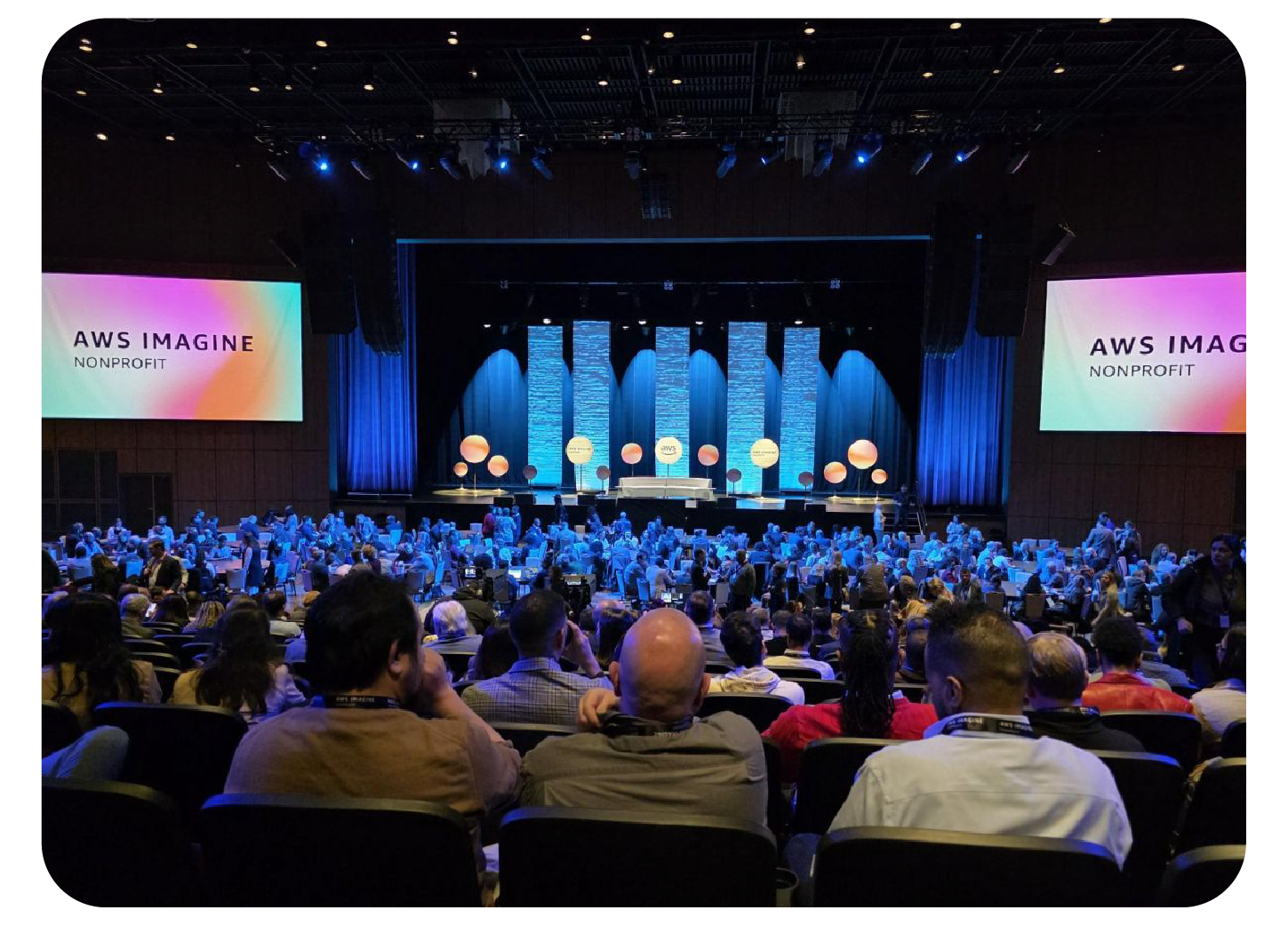
 I spent Thursday at the AWS Imagine Conference. In one day, I had about a dozen conversations with nonprofit leaders — Executive Directors, Development Directors, one CFO who kept getting pulled away by his phone and kept coming back. Different organizations. Different missions. Different parts of the country.
Same problem, every time.
I’ve been watching this pattern for twelve years. There’s something about one day, twelve conversations, that makes a long-standing observation feel very concrete. These aren’t organizations that are behind — several of them were at a cloud innovation conference. They’re paying attention. They’re trying. The problem isn’t awareness or ambition.
The problem is structural.
“The data isn’t the problem. It exists. The intelligence layer is missing.”

The spreadsheet nobody’s supposed to own
Finance has their spreadsheets. Development has theirs. The programs team has their own tracking documents, built over years by whoever was running that program at the time. The CRM holds donor history — when it’s been updated, which is not always. The grants management tool has the pipeline, but it doesn’t talk to the financial system, so reconciling actuals against grant budgets means someone pulling numbers from two places and building a third document that becomes the real record.
The Executive Director is the only person in the organization who sees across all of it. And she’s doing that integration in her head, on nights and weekends, before board meetings and funder calls.
Not bad data. Missing connection. The information exists — what’s missing is anything that turns it into a decision.
And then, trying to solve it, most organizations make it harder.
The SaaS layer makes it worse, not better
Every tool these organizations have added over the years made sense at the time. A CRM for donor management. A grant tracking platform. An accounting system. Google Workspace or SharePoint for documents. Maybe a separate analytics tool because the CRM’s reporting was never quite right.
Each one solved a real problem. Together, they’ve built something nobody designed — a technology stack where the Executive Director is the only integration point, and where adding one more platform adds one more silo to manage.
I heard this directly on Thursday. An ED described how her team had recently added an analytics platform to solve a reporting problem. It worked. It also created two new ones — the data it needed lived in three other systems, so someone had to export it manually before every report run. The solution became a recurring task.
I’ve heard that story enough times that I’ve stopped being surprised. At some point, the workarounds become the job.
This is the SaaS trap. And AI subscriptions — a tab here, a browser extension there — are just the latest layer on top of it.
What I hear every time I ask about AI
It usually starts with a browser tab.
Someone on the development team uses ChatGPT to draft grant narratives faster. Someone in operations has Copilot because it came bundled with their Microsoft license. The Executive Director tried something once, got a confusing output, and moved on.
Every one of those people is getting some value. None of it compounds. None of it belongs to the organization.
When the grants manager leaves, her prompts leave with her. The AI doesn’t know your grant history. It doesn’t know which funders you’ve cultivated for three years versus the ones you found last quarter. It doesn’t know what OMB updated in the last revision to 2 CFR Part 200, or what’s currently open on Grants.gov.
What these organizations have isn’t an AI strategy. It’s a collection of AI habits that live in individuals. Closing that gap is exactly what I’m working to do.
When a team member pastes grant financials, client records, or program data into a public AI tool to get work done faster — and they will, because it works — that’s not just an efficiency decision. That’s a data handling decision with compliance implications that most organizations haven’t addressed.

What solving this actually requires
I want to be direct about what this is and what it isn’t. It’s not another tool to install. It’s not replacing the CRM or the grants platform or the accounting system. It’s creating a layer where all of those sources — plus the sector intelligence that no internal system carries — connect into one searchable, governed environment where anyone on the team can get answers without rebuilding context from scratch.
I’ll be direct about the constraints too: this takes thirty days to deploy properly and requires ongoing management. What it gives back is organizational knowledge that compounds instead of evaporating every time someone opens a new browser tab.
Amazon Quick Suite is what makes the economics work. It brings together Quick Sight for business intelligence and dashboards, Quick Research for deep sector analysis, Quick Flows for automated workflows, and Quick Automate for building agentic processes — all in a single governed workspace. What it doesn’t provide on its own is the configuration, the sector-specific content — Grants.gov, OMB Uniform Guidance, funder intelligence — and the ongoing management that makes it useful on a regular Tuesday morning. That’s the gap the Nonprofit Quick Suite program at Rego fills. We build and manage the foundation. The organization uses it.
A food bank doesn’t need to understand how its cold storage system was engineered. It needs it to work, be maintained, and be there when the truck pulls up on Saturday morning. AI infrastructure should work the same way.
The next articles go deep on specific workflows — grant management, donor intelligence, federal funding compliance. Real constraints, real tools, real outputs.
If you’re already thinking this applies to your situation, I’d rather talk directly than make you wait nine articles.
Ready to talk? Thirty minutes, no slides. → aws.regoconsulting.com
AWS does not lack insight. Cost Explorer, savings recommendations, and rightsizing suggestions surface opportunities constantly. The missing piece is follow-through.
Without clear ownership and cadence, these insights become background noise. Lower spend is the easiest outcome to measure, but it is not the most important. The deeper impact of a clear cloud operating model is decision quality.
When teams agree on roles, review rhythms, and decision rights, debates shift. Instead of arguing about whether something should be “allowed,” teams weigh trade-offs between cost, performance, and risk with shared context. That clarity reduces friction between engineering and finance and speeds up execution.
AWS gives teams enormous power to build and scale. Quick Suite helps them govern that power without killing momentum. Cloud maturity is a practice. And when optimization is built into how decisions get made, teams move from reactive cost cleanup to confident, intentional cloud governance.
Steve Seaney is the AWS Services Business Owner at Rego Consulting, where he leads the Nonprofit Quick Suite program — a pre-configured implementation of Amazon Quick Suite built for mission-driven organizations. He holds an MBA from Kellogg and an MS in Mechanical Engineering from the University of Wisconsin-Madison. He has been building AWS practices at Rego for over twelve years. He thinks in systems. This is Article 1 of 10 in the series “AI That Works for Your Mission.”

About the Author: Steve Seaney