
 Lisa Park had a meeting with Margaret Sullivan, Northstar’s largest individual donor, on Thursday.
She had the gift history going back eight years. What she did not have was the full context behind October. Margaret had replied to Jennifer’s quarterly impact update not just with gratitude, but with an upgrade and a year-end commitment. Lisa had not been part of that exchange. She did not know what Margaret had said, what Jennifer had promised in return, or what the relationship was carrying into Thursday’s meeting.
She asked Maria. Maria was in back-to-back meetings for the week. She emailed Jennifer, who had left six months ago. Jennifer forwarded the October email thread. It told Lisa what Margaret had written. It did not tell her what it meant strategically, or what Maria had planned to do about it.
Lisa walked into Thursday’s meeting prepared. She was not fully briefed.
Lisa Park is a composite, drawn from conversations with development coordinators at organizations that run their donor portfolios exactly this way.
🧠 The donor relationship lives somewhere
Major gift fundraising is relationship-dependent by design. The ask is personal. The cultivation takes time. The donor’s motivations, interests, hesitations, and prior commitments are the context that makes a conversation either productive or clumsy.
That context lives somewhere. The problem is where.
At most mid-size nonprofits, donor intelligence is distributed across the executive director’s memory, the development director’s inbox, the major gifts coordinator’s call notes, a CRM that may or may not be current, and a shared folder of proposals and correspondence that no one has had time to organize. Each person holds a piece. Nobody holds all of it. When someone leaves, their piece leaves with them.
This is not negligence. It is what happens at organizations running lean, where staff wear multiple roles and systems are chosen for what they cost rather than what they connect. The executive director knows the major donors because the executive director is the relationship. The development director knows the grant funders because she has been working them for three years. The major gifts coordinator knows what she has been told. That is most of what she needs, until the meeting where the rest of it matters.
The executive director knows the major donors because the executive director is the relationship. When she leaves, the relationship has to be rebuilt from scratch.

🪙 The cost of the transition
 Staff transitions are where donor intelligence breaks down visibly.
An executive director leaves after seven years. She has cultivated the organization’s twelve largest individual donors personally. She knows which ones prefer a phone call over an email. She knows which one had a difficult conversation with the board chair in 2022 that was resolved but not forgotten. She knows which one has signaled willingness to increase their commitment if the right program comes together.
Her successor inherits a donor list. Not a donor relationship.
The rebuild takes two to three years at organizations that are deliberate about it. At organizations that are not, it takes whatever time it takes before a donor quietly stops responding and the next annual report shows a gap in the major gifts line.
Development directors transition too. So do board members who carry corporate funder relationships. So do program managers who have spent years building trust in a community they serve. None of this knowledge is captured in a way that survives a handoff.
The loss does not appear on any financial statement. It appears in the pipeline, eighteen months later, when the asks that should have been ready are not.
This problem is not unique to nonprofits. Any organization that runs on client relationships faces the same structural risk: the financial advisory practice where the senior partner carries the client history personally, the consulting firm where the engagement lead is the only one who knows what a particular client said two years ago, the agency where account knowledge lives in one person’s notebook and nowhere else. The structure does not change by sector. It surfaces the same way in every case: one person leaves, and the organization spends the next year finding out what walked out with them. The framing is different across sectors. The vulnerability is the same.
🤝 What the organization actually needs
 The problem is not that donor intelligence exists. It is that it exists in the wrong places, in formats that do not travel and cannot be searched.
What changes the outcome is not a better CRM. It is a deliberate organizational decision, not a technical one, to treat relationship history as institutional property rather than personal knowledge. Meeting notes that currently stay verbal need to be written down. Funder briefings that live in the development director’s head need to exist somewhere the next person can find them. A conversation after a major donor event, the kind where the executive director comes back with three things she learned, needs a home that is not her inbox.
Most organizations know this. The reason it does not happen is not indifference. It is that documenting a donor conversation takes time that does not have a line on any grant budget, and there is always something more urgent competing for the same thirty minutes.
The organizations that solve this problem solve it by making the documentation lighter and the retrieval faster, so that the habit is easier to sustain than to abandon. A brief note after a call. A shared folder where the major gifts coordinator can drop a proposal without building a filing structure first. A place to ask a question and get an answer drawn from what the organization actually knows, rather than tracking down the person who was in the room.
That is what Northstar built. Not a system. A practice, with infrastructure behind it.
👩💻 How it changed Lisa’s meeting
The problem is not that donor intelligence exists. It is that it exists in the wrong places, in formats that do not travel and cannot be searched.
What changes the outcome is not a better CRM. It is a deliberate organizational decision, not a technical one, to treat relationship history as institutional property rather than personal knowledge. Meeting notes that currently stay verbal need to be written down. Funder briefings that live in the development director’s head need to exist somewhere the next person can find them. A conversation after a major donor event, the kind where the executive director comes back with three things she learned, needs a home that is not her inbox.
Most organizations know this. The reason it does not happen is not indifference. It is that documenting a donor conversation takes time that does not have a line on any grant budget, and there is always something more urgent competing for the same thirty minutes.
The organizations that solve this problem solve it by making the documentation lighter and the retrieval faster, so that the habit is easier to sustain than to abandon. A brief note after a call. A shared folder where the major gifts coordinator can drop a proposal without building a filing structure first. A place to ask a question and get an answer drawn from what the organization actually knows, rather than tracking down the person who was in the room.
That is what Northstar built. Not a system. A practice, with infrastructure behind it.
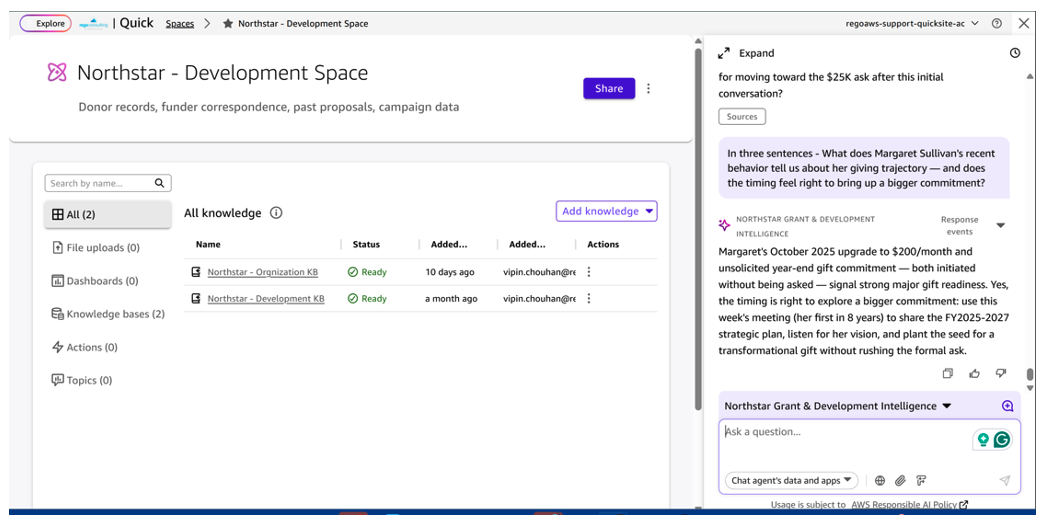
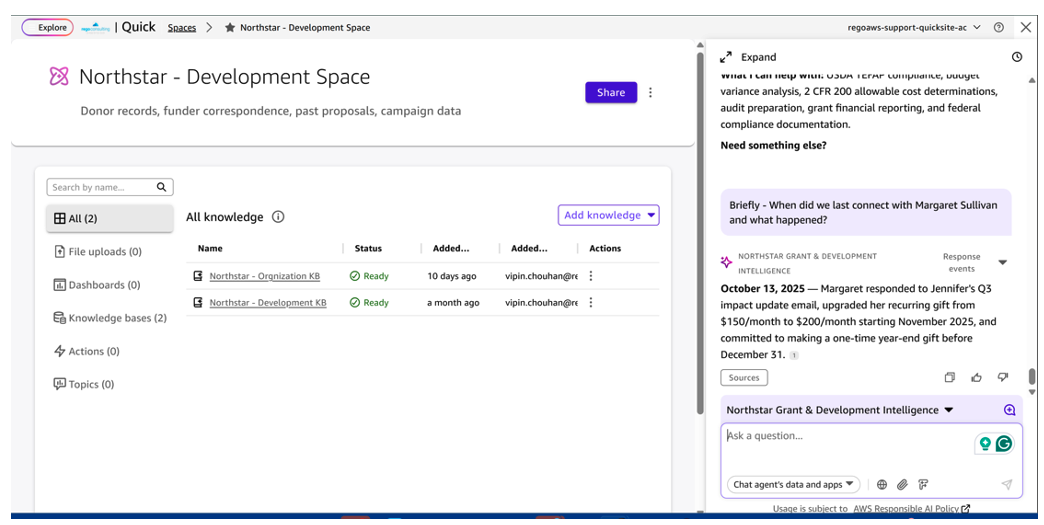
Before Thursday, Lisa asked a question in Northstar’s Development Space: what is the current status of Margaret Sullivan’s relationship with Northstar, and what happened in the October email exchange?
Twenty seconds later she had the October email thread, Margaret’s full giving history going back eight years, and the internal development notes Jennifer had written after the exchange.
The Chat Agent did not just retrieve those documents. It identified that Margaret’s October email contained two unprompted financial signals: an upgrade from $150 to $200 per month and a commitment to a year-end gift, neither of which had been solicited. It connected those signals to an internal development note flagging Margaret as a candidate for a $25,000 named gift tied to Fresh Start expansion, with the standing guidance: relationship first, do not rush the ask. The suggested talking point it returned was specific: open by acknowledging the upgrade and the year-end commitment, share the FY2025–2027 Fresh Start expansion vision, and listen for signals about the role she wants to play. That is not a search result. That is preparation.
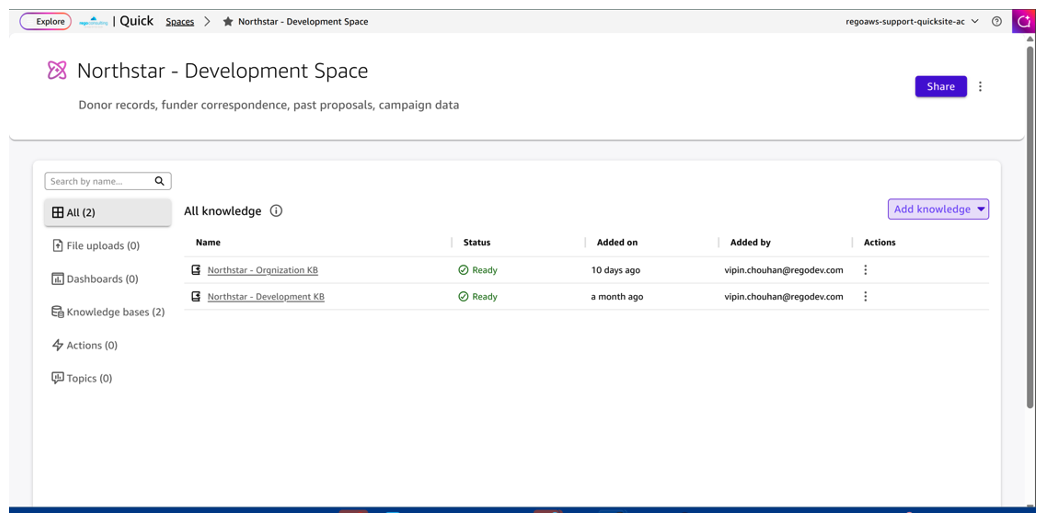
She did not get that answer because the technology is impressive. She got it because someone wrote down what happened in October and documented the strategic interpretation alongside the facts. Someone made Jennifer’s internal notes accessible rather than leaving them in a personal folder. The documentation discipline came first. The retrieval was a consequence.
That distinction matters. The platform did not create institutional memory. It gave institutional memory a place to live and a way to be accessed. Those are different things, and only one of them requires a technology purchase.
The documentation discipline came first. The retrieval was a consequence.
Lisa walked into Thursday’s meeting knowing what the October exchange had started. She knew what Margaret had committed to and what she had not yet been asked. She knew the year-end gift was pending and that the strategic notes pointed toward a much larger conversation about Fresh Start. The conversation went differently than it would have otherwise.
⚙️ What it does not solve
If the conversation was never written down, the platform cannot surface it. That is the honest constraint.
What Northstar found was that the act of building the Development Space forced a conversation they had been deferring: what do we actually know about our major donors, and where does it live? For several relationships, the answer was that it lived entirely in Maria’s memory. No note. No record. Nothing transferable.
The platform did not fix that gap. It made the gap visible. Northstar addressed it by building a post-event documentation habit. Thirty minutes after any significant donor interaction, whoever was in the room writes a brief note and uploads it. Not a formal record. A note.
Six months in, the Development Space reflects how the organization actually operates, not a sanitized version of it. That is more useful than a system that looks complete but is not.

🔎 The practice before the platform
 If an organization is considering this kind of infrastructure, the most useful question to ask before the technology conversation is this: if your executive director left next month, how much of your major donor relationship history would survive the transition?
If the answer is most of it, the documentation practice is already there and the infrastructure is an accelerant. If the answer is some of it or not much, the infrastructure can still help, but the discipline has to come with it.
The thirty-day deployment builds the technical foundation. What takes longer is the organizational habit of treating relationship intelligence as something that belongs to the institution, not the individual who holds it. That habit is worth building whether or not the platform is in the picture.
For Northstar, the platform made the habit sustainable in a way that a shared folder and good intentions had not. Lisa Park did not need to know everything Jennifer knew. She needed to be able to find it. Now she can.
Ready to talk? Thirty minutes, no slides. → aws.regoconsulting.com
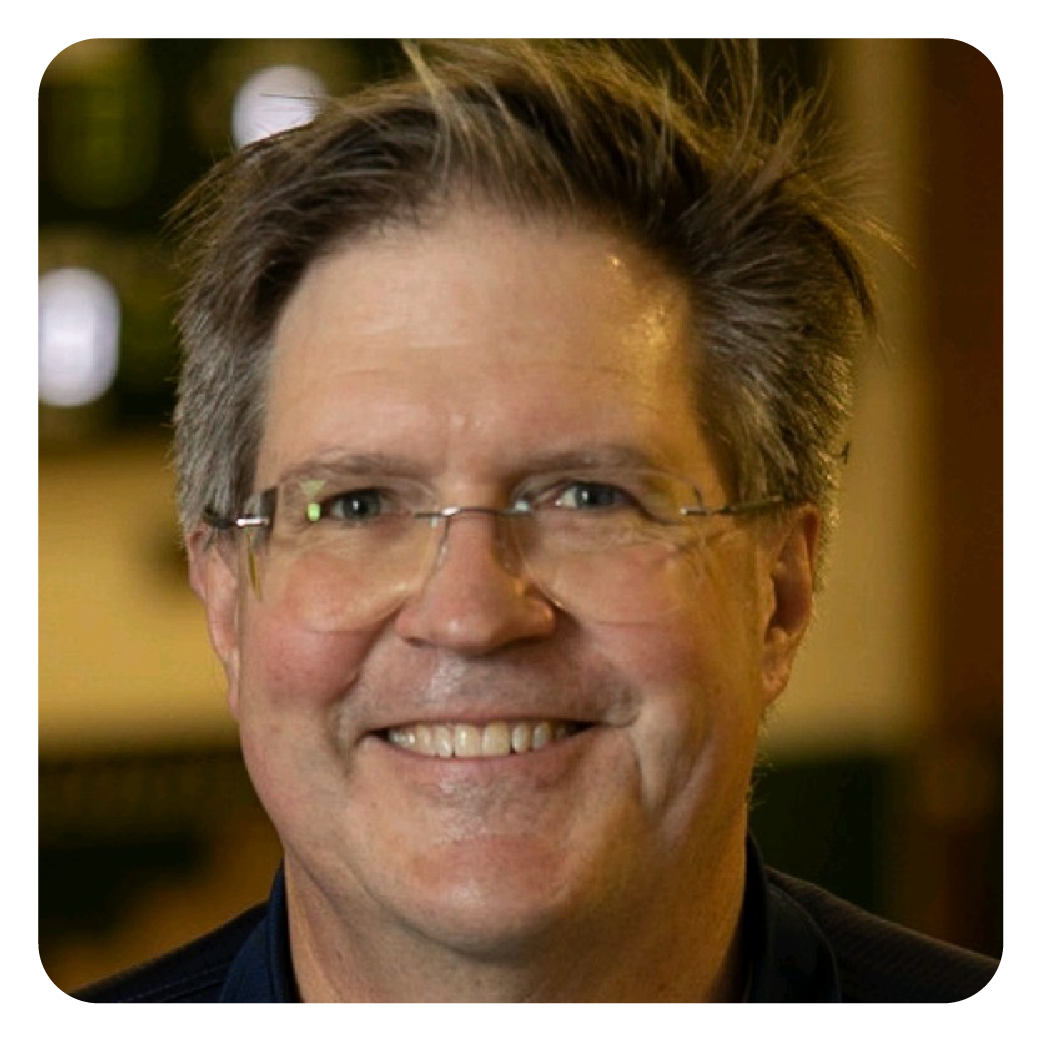 Steve Seaney is the AWS Services Business Owner at Rego Consulting, where he leads the Nonprofit Quick Suite program — a pre-configured implementation of Amazon Quick Suite built for mission-driven organizations. He holds an MBA from Kellogg and an MS in Mechanical Engineering from the University of Wisconsin-Madison. He has been building AWS practices at Rego for over twelve years. He thinks in systems. This is Article 2 of 10 in the series “AI That Works for Your Mission.”

About the Author: Steve Seaney