
Strategic Leadership: The Power of Reduction to Drive Business Growth
Inspired by Juliet Funt’s Strategic Choice framework — JulietFunt.com
The Question That Stopped Me in My Tracks
“What do you wish you could stop doing?”
When Juliet Funt posed that question at the Global Leadership Summit, you could feel the collective pause … part shock, part relief. After all, when was the last time anyone in leadership invited you to stop? My mind raced into the wide horizons that this question created: Stop doing what? The meeting that’s lasted longer than some marriages? The report no one reads but everyone is expected to update? The constant “yes” reflex that leaves no space to think?
This free thinking is exactly why Funt champions that question. She has seen it light up organizations from Silicon Valley boardrooms to Air Force bases.
Why this powerful question works:
People see inefficiencies daily, but need permission to speak up. This prompt creates psychological safety around reduction.
 Funt confirmed this question works with any group. Once you unlock people’s permission to talk about what they wish they could stop, the ideas flow freely.
It’s the first step in acknowledging that endless addition isn’t leadership. It begins the gentle, courageous act of removing the obstacles in our path.
At Rego Consulting, we’ve seen organizations suffer when they don’t evaluate their practices. Claiming “We’ve always done it this way,” is complacent thinking, and doesn’t lead to success. Teams want to lead at a higher level, but end up buried under layers of well-intentioned clutter, such as extra reports, legacy meetings, or duplicate processes. The result? Everyone’s busy, but no one’s gaining altitude.
Funt’s concept of Strategic Choice and Reductive Mindset offers an antidote. It’s not about doing more, or even doing better – it’s about intentionally prioritizing to do less. When leaders model subtraction, they don’t lose momentum. They create space where real focus and real results can accelerate.
The Reductive Mindset creates space for leaders and teams to:
The Leadership Gluttony Trap

Do you know precisely where you want your leadership to take you and your team?
Or, like most people, is your vision clouded by too many projects, plans, and tasks?
We’ve all done it. You start with one strategic goal, and before long, you’ve got a dozen. Funt calls this “leadership gluttony.” It’s the irresistible urge to pile our plates high with projects, improvements, and new initiatives. It feels productive, even noble, to say “yes” to everything. But as Funt aptly predicts, “If you’re spreading the peanut butter that thin, you’re gonna rip the bread.”
You realize your team isn’t growing stronger, they’re just spinning their wheels. The buffet of “good ideas” becomes a burden. And here’s the kicker: while you’re juggling twelve balls, your competitors are quietly perfecting one throw.
Funt calls for a new kind of discipline: precision over accumulation. It’s about narrowing the field so the remaining work moves the mission forward in a meaningful way. As she puts it, “We are not infinite, but the work is.”
Enter the Reductive Mindset
The Reductive Mindset – the radical idea that progress often means doing less – is the heart of Funt’s philosophy.
She describes three ways organizations typically approach improvement:

The process of reduction is where courage and true leadership come in. Because it’s not hard to cut the bad stuff. The real challenge is cutting good things in favor of great ones. Funt shared a poignant story of survival, driving home that, “Sometimes you have to drop your gold [which has value in some situations, but is too heavy to carry], to get where you’re going.”
The challenge of letting go of the good – in favor of the best – begins with a mindset shift. Funt points to the “IKEA effect,” a cognitive bias where we place a higher value on projects or processes that we’ve invested in or personally created. Can you recognize this tendency in yourself? Can you see the danger of protecting projects or processes, even if they no longer serve you?
The reductive mindset invites us to let go of unnecessary attachment, and ask, “What if less isn’t loss? What if it’s leadership?”
The Spin Launcher: A Flight Path for Focus
So, how can you put a reductive mindset into practice?
Funt offers a process called The Spin Launcher, a five-step framework designed to help you and your teams “make your pile smaller.”

Step 1: Generate
Start with Funt’s powerful question: “I wish we could stop ___.”
Hand your team a stack of sticky notes (or a virtual equivalent) and let ideas flow. You’ll be amazed how quickly people name what’s dragging them down, once they’re given permission to say it.
Consider these additional prompts to keep ideas flowing:
- Battle Rhythm Review: Reduce the occurrence of tasks. What tasks can move from daily to weekly? Weekly to monthly? Monthly to quarterly?
- Seasonal Sweep: Reduce seasonal overload. Go through the calendar month by month. Identify and reduce overwhelming projects.
- Tuna vs. Krill: Look for both big reductions (tuna), like cancelling major projects, and small reductions (krill), such as shaving five minutes off meetings. Don’t underestimate the exponential impact of small reductions!
- Subtask Reduction: If you cannot cut an entire project, remove or simplify components within it, such as reporting or approval processes.
Step 2: Separate
Separate the things you can control from the things you cannot.
Leaders often waste energy on what's beyond their reach. Funt clarifies why the things we cannot control are appealing but worthless, stating, "The many things you can't control can become a spectacular rationalization for ignoring the things you can."
Sort the ideas into two piles:
- Can Control
- Can't Control
When you focus on what you can control, you'll reduce frustration and redirect your team's efforts to areas that drive impact.
Step 3: Evaluate
Working with the “Can Control” pile, use Funt’s framing to sort work into high-value work and low-value work. For each idea, consider: Is it best to let it go, keep it, or shrink it? Funt’s measuring stick is to “determine what creates the most value for your mission.”
- ✅ Retain the 4 Rs of High-Value Work: Revenue, Reputation, Reward, Readiness
This includes work that:- Grows your business.
- Strengthens your brand.
- Fuels people’s sense of accomplishment.
- Prepares your team for future success.
- ❌ Purge the 4 Ps of Low-Value Work: Panicking, Pandering, Procedure, Padding
This work is unprofitable, but all too common:- Panic is the work we grab in a rush, projects born from impulse instead of intention. We say “yes” too fast and think too late.
- Pandering is the detour we take to please someone powerful when we can’t quite find the courage to say “no.”
- Procedure is the swamp of unnecessary steps we slog through.
- Padding is comprised of all those extra words, emails, and layers that accumulate and make the work feel heavier than it needs to be.
Funt shared a surprising antidote that reinforces the negative power of padding. “One of our Airforce wings knew their reports were so padded that they put in one report that an asteroid hit the base. No one ever noticed.”
Avoid demoralizing your teams with low-value work, and commit to prioritizing high-value work.
Step 4: Eliminate
The next essential step is elimination – where ideas becomes action. Without it, teams can refine, rethink, and rehash ideas forever, without actually reducing the load. Funt implores us to step over the line and take action. It all begins with someone stating, “I suggest …” or “I propose …”
Once the team agrees to reduce an item, it earns a spot on the Reductive Wins Board. Every item has an owner (who will take action) and a deadline (a specific date), so ideas don’t drift away once the meeting ends.
A quick word of caution: If you’ve recently been bingeing on minimalism documentaries, or helping your hoarder friends move, you may be inclined to oversimply. If you find that you’ve tossed out the baby with the bathwater, don’t panic. You can always retrieve what matters. Remember that the goal of this exercise is a thoughtful edit, and you don’t have to toss everything in one session.
Step 5: Liberate
This is the payoff! Experience the freed-up capacity, creativity, and calm that returns when people finally stop spinning their wheels. Enjoy the productivity and renewed passion of accomplishing high-value work.
“All of this focus on the reductive mindset is to do one thing, and that is the fifth step: to liberate your people, to take every single beautiful spark of their talents and energy and make sure that it is firing on valuable, important work.”
– Juliet Funt
Funt’s Spin Launcher is an elegantly structured path for organizations of any size, and what makes it powerful is the honoring of our human nature and capacity. It’s a process that can breathe life into your most valuable projects and provide dramatic results!
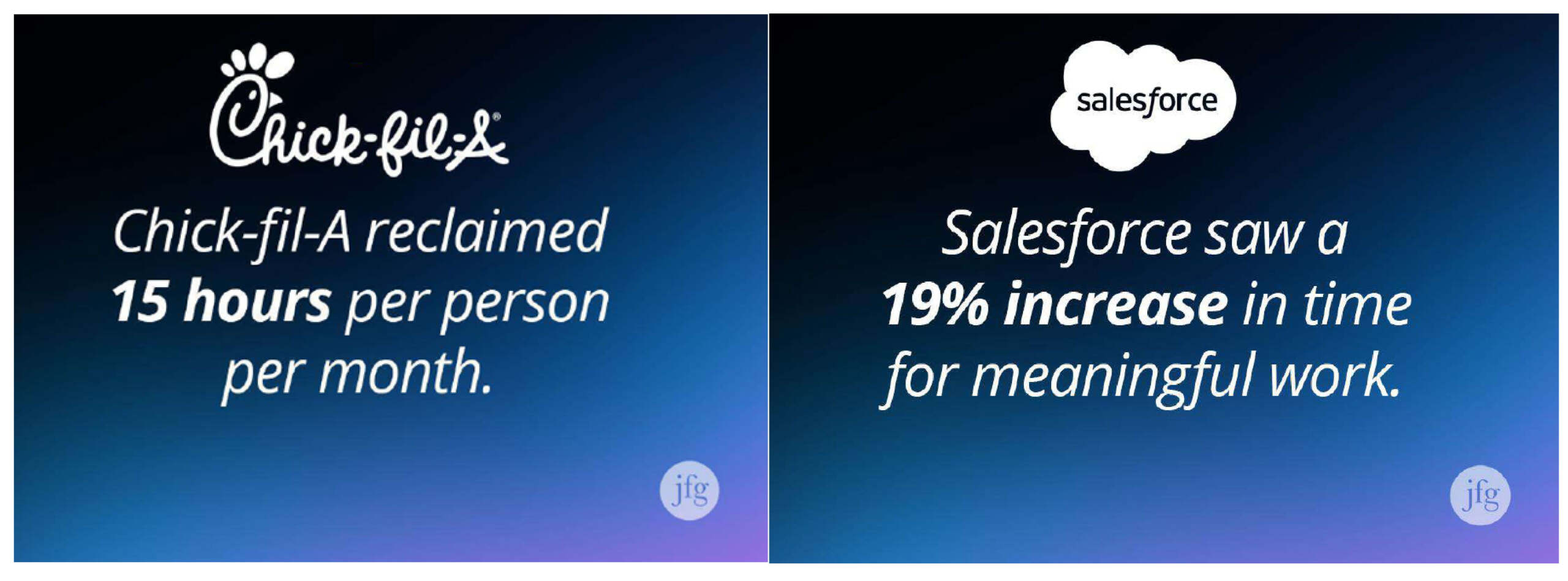
Chick-fil-A and Salesforce saw significant improvements when they implemented the Reductive Mindset and the Spin Launcher framework.
Follow-up and Maintenance
Funt cautions that most people want reductive work to “act like plastic surgery: cut once and everything stays beautiful forever.” However, reality is more akin to a haircut. To sustain your progress, it’s essential to understand that reductive work requires regular maintenance.

Schedule:
- Individual Reductive Trims: one hour monthly for each team member.
- Schedule one hour every month just to take things away from your own schedule.
- Team Reductive Trims: three hours quarterly for the whole team.
- Go through The Spin Launcher process as a team.
Each iteration of the Spin Launcher streamlines your organization and propels you to higher success.

Model Reduction as a Leadership Behavior
What’s one of the most powerful things a leader can do? Transparently model reduction. When leaders make a visible decision to subtract, it signals to their teams that “enough” is a mark of wisdom, not a failure of ambition.
Perhaps it’s canceling a weekly meeting that’s lost its purpose. Or shortening an approval chain. Maybe it’s making a “Hate Map” of future items to reduce, as one of Funt’s brave clients did, committing to address each item:

Try this: Pick one thing to pause, simplify, or stop this week, and share your reasoning. That transparency turns subtraction into shared growth.
For optimal success, Funt encourages leaders to embrace the following ideas as well. They will help you maintain the reductive gains between formal sessions and prevent your team from becoming overloaded again.
And, of course, celebrate each reductive win! 🎉
Maintaining the Lift – Lessons from the Sky
Funt concluded her Global Leadership Summit session with a story that feels almost cinematic. She describes flying in a fighter jet (the T-38 Talon) that achieves supersonic speed, not through brute force, but through … you guessed it: reduction. Engineers have stripped away everything nonessential, including weighty metal components like radar systems and hydraulics.
The result? Speed, agility, and effortless climb.
That image sticks. Because leadership works the same way. The fewer unnecessary parts we carry, the higher we can go.

Closing Reflection – The Freedom of Focus
Funt’s Strategic Choice isn’t just a framework – it’s a permission slip for success. It’s a call to lead with less, and to find the courage to reduce. When you lighten your load, you can move forward freely with momentum to do the work that truly matters.
So, what do you wish you could stop doing?
That single question might be the most transformative leadership tool you’ll ever put into practice. Because once you start naming what no longer serves your mission, you free up the space to think, create, and lead.
Shrink the pile. Take back focus. And go supersonic.
Partner with Rego to Lighten Your Load
At Rego, we know the courage to do less isn’t easy — it’s strategic. For nearly two decades, we’ve helped organizations remove unnecessary complexity, streamline systems, and regain focus. From simplifying Strategic Portfolio Management (SPM) / Project Portfolio Management (PPM) to optimizing transformation workflows, we turn complexity into clarity. Our expert guides bring frameworks like Juliet Funt’s Strategic Choice to life, helping leaders simplify, make well-aligned decisions, and free their teams to do their best work.
It’s rewarding to see simplicity and precision cascade throughout the organization. People breathe again. They collaborate more freely. The daily work feels lighter, and the purposeful passion returns. As a result, success gains velocity.

If your organization feels weighed down by too many priorities, meetings, or “must-do” projects, it’s time for a reductive reset. Rego can help you make space for what matters most.
Let’s simplify your path to success.
Contact Rego Consulting to start your transformation.
Attribution
This article references the Strategic Choice framework and Reductive Mindset created by Juliet Funt and the Juliet Funt Group. Used with permission.
Learn more at JulietFunt.com.

About the Author: Liz Rodgers